
Your year-end bonus could fund a few weeks of festive enjoyment. Or it could become the starting point of a stronger financial future. With the SARS tax year ending on 28 February 2027, now is the time to give your money a purpose.
There is something special about receiving a year-end bonus.
After twelve months of hard work, deadlines, responsibilities and commitments, that additional amount in your bank account feels like a well-deserved reward. Perhaps you have already started planning the December holiday, upgrading your home, replacing an appliance or treating the family to something special.
And why not? Money should allow you to enjoy life, not simply work towards a distant retirement date.
But before your bonus disappears into the festive season, consider a question that could change how you approach it:
What if this year’s bonus could do more than make December memorable? What if it could help make your future more financially secure?
Why You Should Think Twice Before Spending Your Year-End Bonus
For many people, the year-end bonus arrives at precisely the wrong time for long-term financial discipline.
December brings holidays, family gatherings, gifts, travel, entertainment and the pressure to make the festive season special. January follows with school expenses, insurance premiums, debit orders and the general cost of getting back into routine.
Before long, the bonus has been spent — sometimes without a clear understanding of where it went.
The problem is not necessarily that the money was spent irresponsibly. It is that an opportunity to strengthen your financial position may have been lost without much thought.
Imagine receiving a bonus of R30,000.
You could spend the entire amount on additional festive-season expenses and have wonderful memories to show for it. Alternatively, you could allocate a portion to enjoy December, use another portion to reduce expensive debt or strengthen your emergency savings, and invest the balance towards a longer-term goal.
Both approaches allow you to enjoy the festive season. But only one deliberately makes provision for tomorrow.
The real question is not whether you should enjoy your bonus. It is whether you want all of it to be spent on today.
What Happens When You Invest Your Bonus for 10 Years?
Consider setting aside just R15,000 from your annual bonus and investing it every year.
Assuming an illustrative annual investment return of 8%, compounded annually, the results could be surprising.
After ten years:
- Total contributions: R150,000.
- Illustrative investment growth: R67,298.
- Potential investment value: R217,298.
You have not had to invest your entire bonus. You have simply made a decision to put a portion of it to work.
The difference is even more significant when you consider what happens over a longer period.
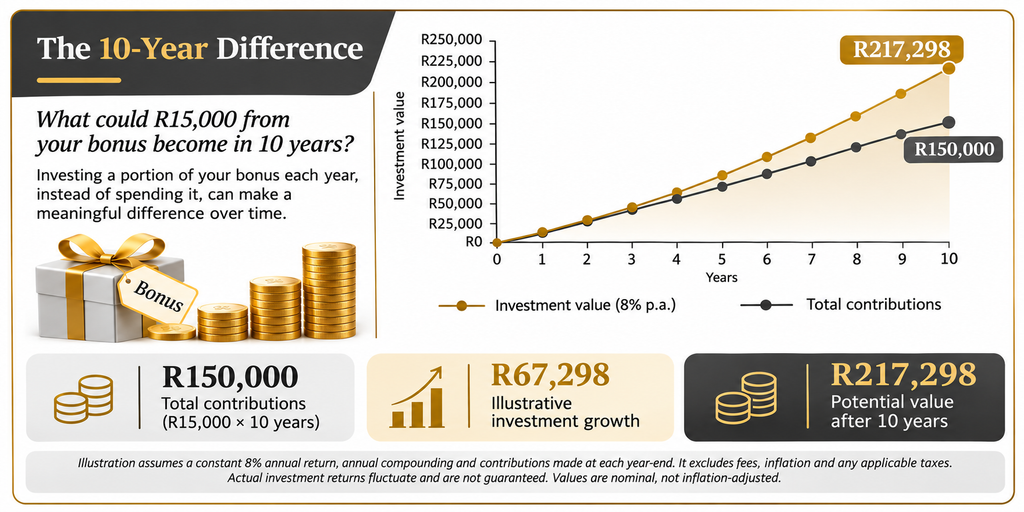
See the 10-year investment illustration above.
How Reinvesting Your Tax Refund Could Build Long-Term Wealth
Now consider someone who is 45 years old and has approximately 20 years until retirement.
They receive an annual tax saving or refund of R30,000 as a starting illustration, arising from qualifying retirement-fund contributions. As their salary and qualifying retirement contributions increase over time, we assume this annual tax saving increases by 5% per year.
Instead of spending the money, they decide to reinvest it, together with R15,000 from their annual bonus.
Using the following assumptions:
- Starting annual tax saving: R30,000.
- Annual increase in tax saving: 5%.
- Additional annual bonus investment: R15,000.
- Assumed investment return: 8% per annum.
- Investment period: 20 years.
The potential outcome is approximately R2.69 million by age 65.
Of this amount, approximately R1.29 million represents contributions and R1.40 million represents illustrative investment growth.
Compare this with someone who receives the same additional money but spends it every year. They may have enjoyed the extra income along the way, but they would have accumulated no additional investment capital from these amounts.
This example demonstrates how consistency, increasing contributions and compound growth can work together over time.
It is important to understand that a tax refund is not automatically generated by an RA contribution. The actual tax benefit depends on the individual’s taxable income, marginal tax rate, existing retirement-fund contributions, available deduction capacity and PAYE position. The 5% annual increase is an illustrative assumption, not a guaranteed salary or inflation adjustment.
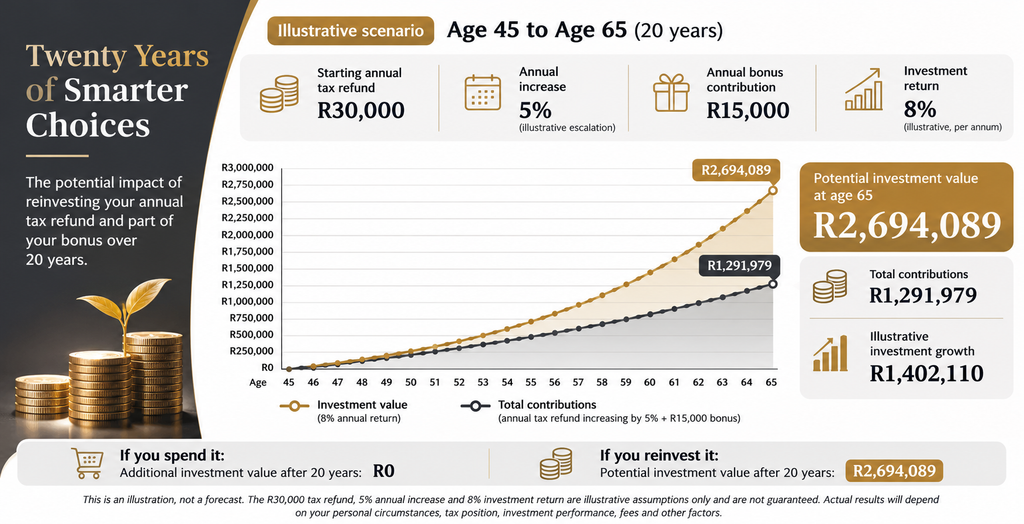
See the 20-year investment illustration above.
Tax-Efficient Investing Before the February Tax Deadline
South Africa’s tax year ends on 28 February 2027. This creates an opportunity to review your retirement contributions and investment strategy before the deadline.
Two investment vehicles deserve particular attention: Retirement Annuities and Tax-Free Savings Accounts.
1. Retirement Annuity Contributions and Tax Deductions in South Africa
A Retirement Annuity (RA) can be an effective way to strengthen your retirement provision while potentially reducing your taxable income.
For the 2027 tax year, qualifying contributions to pension, provident and retirement annuity funds are deductible up to the lesser of:
- 27.5% of the greater of remuneration or taxable income; or
- R430,000 per year.
This limit applies collectively to qualifying retirement-fund contributions, rather than separately to each fund.
For someone who has additional disposable income from a bonus, making an additional qualifying RA contribution before the end of February could provide an opportunity to improve retirement provision and potentially obtain a tax benefit.
However, it is important to consider your existing retirement contributions, particularly if you are a member of the Government Employees Pension Fund (GEPF).
Your GEPF contributions already form part of the retirement-fund contribution deduction calculation. An additional RA contribution should therefore be evaluated against your available deduction capacity.
An RA is also a long-term retirement investment with specific access and withdrawal restrictions. It should be selected because it suits your retirement strategy, not simply because it offers a potential tax deduction.
2. Should You Invest Your SARS Tax Refund in a TFSA?
What happens when SARS pays you a tax refund?
For many people, it becomes additional spending money. But there is another possibility: reinvest it.
A Tax-Free Savings Account (TFSA) offers an attractive opportunity to build wealth over the long term.
From 1 March 2026, the annual TFSA contribution limit increased to R46,000, with a lifetime contribution limit of R500,000 per individual.
The investment returns within a qualifying TFSA are exempt from:
- Income tax.
- Dividends tax.
- Capital gains tax.
Unlike an RA, a TFSA also offers greater withdrawal flexibility.
However, there are important contribution restrictions. The annual and lifetime limits apply across all your TFSA accounts combined. Unused annual contribution allowance cannot be carried forward, and contributions exceeding the limits attract a 40% tax penalty.
This means that if you receive a tax refund, you should first establish how much TFSA contribution allowance remains available to you.
3. Why not combine the two strategies?
An interesting approach is to consider using both investment vehicles as part of a coordinated financial strategy.
For example:
- Allocate a portion of your annual bonus towards an additional qualifying RA contribution, where appropriate.
- Benefit from the potential tax deduction, subject to your available deduction capacity and actual tax position.
- When a tax refund or tax saving becomes available, consider reinvesting it into a TFSA, subject to your remaining contribution allowance.
- Invest any additional amount that cannot be accommodated within your TFSA into another suitable investment vehicle.
This creates an opportunity to build retirement capital through your RA while also accumulating a more accessible, tax-efficient investment portfolio through your TFSA.
The important consideration is to ensure that your investments are structured appropriately and that you do not exceed the applicable contribution limits.
GEPF Members: Making Additional Provision for Retirement
For public-sector employees who belong to the Government Employees Pension Fund, the bonus conversation should form part of a broader retirement-readiness assessment.
Your GEPF pension is an important component of your retirement provision, but it should not automatically be treated as the only financial resource you will ever need.
Consider your expected retirement income alongside your household expenses, outstanding debt, other investments, future medical costs and the lifestyle you would like to maintain.
Will your anticipated retirement income comfortably support that lifestyle?
Do you have sufficient provision for unexpected expenses?
Would additional discretionary investments or an appropriately structured retirement annuity help you achieve financial goals that fall outside your GEPF benefits?
These questions become increasingly important as retirement approaches.
For members who are several years away from retirement, an annual bonus may provide an opportunity to build additional savings. For those closer to retirement, it may be an opportunity to review whether their existing strategy remains appropriate.
The objective is not simply to accumulate money. It is to understand what your money needs to achieve.
Do not wait until February to make a decision
One of the most common mistakes in financial planning is leaving important decisions until a deadline is almost upon you.
By then, there may be insufficient time to evaluate your options properly, obtain the necessary information and implement an appropriate strategy.
Instead, use the festive season as a starting point for a financial review.
Ask yourself:
- How much of my bonus can I comfortably spend without compromising my financial goals?
- Do I have expensive debt that should take priority?
- Is my emergency reserve adequate?
- Am I making sufficient provision for retirement?
- Have I used my available TFSA contribution allowance?
- Could an additional qualifying RA contribution improve my retirement provision and tax position?
- What should I do with my next SARS tax refund?
You do not need to have all the answers immediately. You simply need to start asking the right questions.
Give your bonus a purpose
The festive season should be enjoyed. You have worked hard throughout the year, and there is nothing wrong with allocating money towards the experiences and people that matter to you.
But your future deserves a place in those decisions, too.
A bonus can be an opportunity to do something meaningful: reduce financial pressure, strengthen your savings, improve your retirement provision or begin an investment you have been postponing.
You may not remember every purchase you made this December. But the financial habits you establish today could influence your choices for many years to come.
One bonus. Two futures.
One is shaped by what your money can buy today. The other is shaped by what your money can make possible tomorrow.
You do not have to choose between enjoying your life and preparing for the future. With a considered plan, you can make room for both.
Make your next financial decision count
At Pristine Wealth, we believe that financial decisions should be tailored to your circumstances, your priorities and the future you want to build.
Whether you are a GEPF member approaching retirement or a professional looking to strengthen your investment portfolio, a review of your current position can help identify opportunities and potential gaps in your financial plan.
Before the February tax-year-end deadline, consider speaking to an independent financial adviser about the options available to you.
Pristine Wealth
Independent Advice. Tailored Wealth.